



If you searched "battery operated table lamp," you are looking for one thing: a lamp that works without being plugged into a wall. You want cord-free light on a nightstand, a dining table, or a patio — and you want it to just work.
The challenge is that "battery operated" describes two very different products in 2026. One costs $15 and runs on disposable AAs. The other costs $179-$579 and runs on built-in rechargeable lithium-ion. They solve the same problem — cordless light — but the technology, the cost over time, the light quality, and the environmental impact are not remotely comparable.
This guide breaks down the real differences so you can make an informed choice.
What "Battery Operated" Actually Means in 2026
Two categories of lamp share the "battery operated" label:
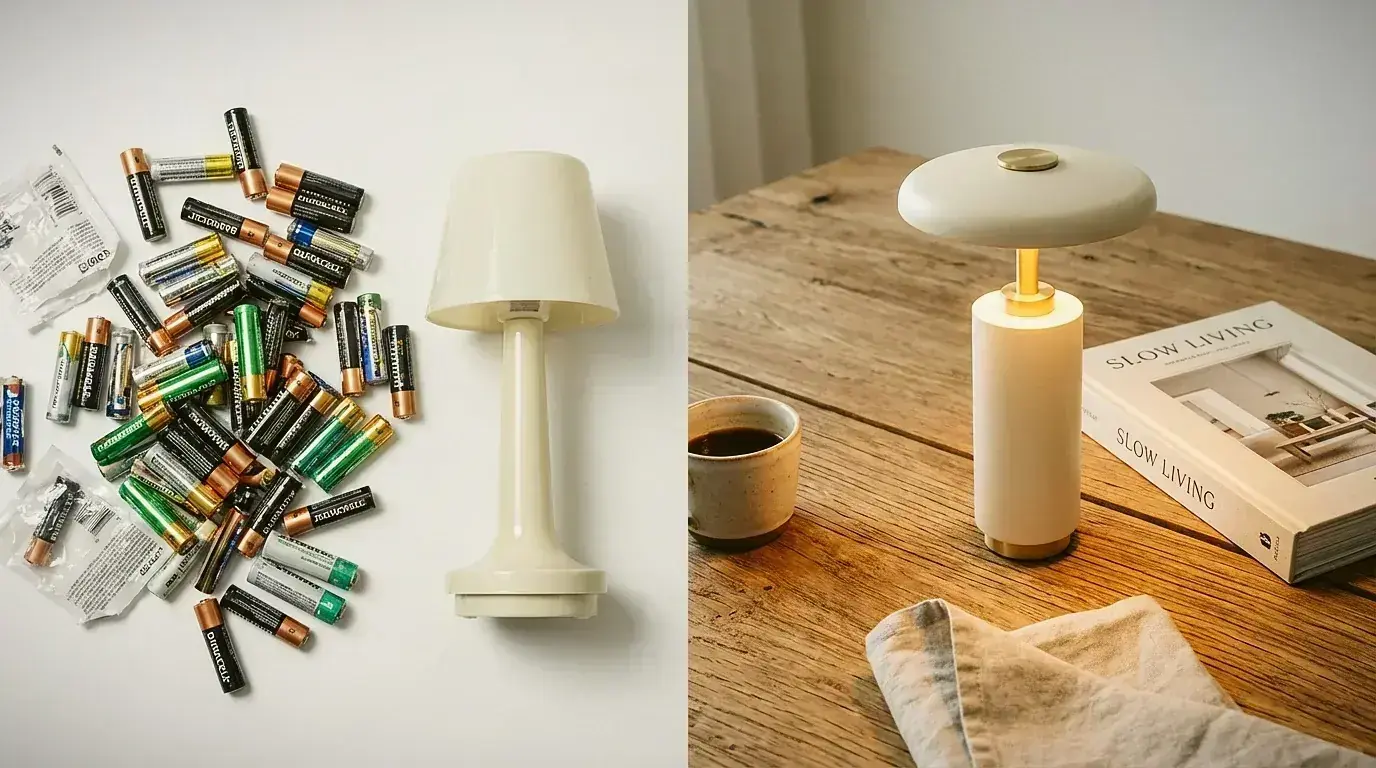
Type 1: Disposable Battery Lamps These use standard AA, C, or D alkaline batteries — the same kind you put in a flashlight or a TV remote. You can find them at Target, Walmart, and Amazon for $10-40. When the batteries die (typically 15-30 hours of use), you replace them.
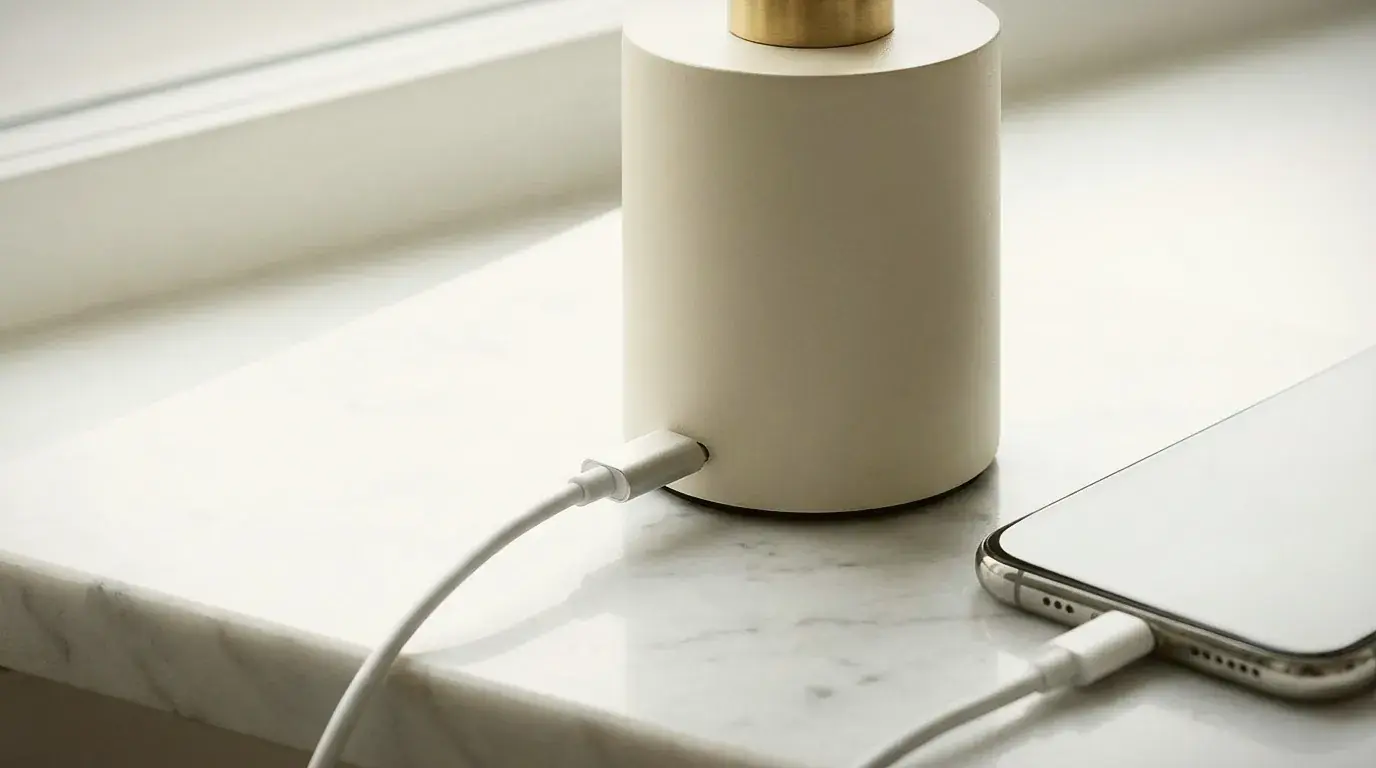
Type 2: Rechargeable Lamps These use a built-in lithium-ion battery — the same technology that powers your smartphone. You charge them via USB-C, use them cordlessly for hours to weeks, then recharge. No disposable batteries, no battery compartment, no waste. Prices range from $179 for a compact design to $579 for a premium flagship.
Both deliver cord-free light. But the similarities end there.
The Real Cost: Disposable Batteries vs USB-C Recharging
This is where the math dismantles the "cheap lamp" argument.
Disposable Battery Lamp — True Cost
A typical AA-powered table lamp uses 4 batteries and runs 8-10 hours per set at full brightness. At 4 hours of daily use:
| Cost Factor | Year 1 | Year 3 | Year 5 |
|---|---|---|---|
| Lamp purchase | $25 | $25 | $50 (replaced once) |
| AA batteries (~$2/set, replaced every 2-3 days) | $280 | $840 | $1,400 |
| Total | $305 | $865 | $1,450 |
That $25 lamp is not cheap. It just hides its cost in the battery drawer.
Rechargeable Lamp — True Cost
A Cassia at $249 charges via USB-C. The electricity cost per charge is fractions of a cent — effectively $0 over any timeframe that matters.
| Cost Factor | Year 1 | Year 3 | Year 5 |
|---|---|---|---|
| Lamp purchase | $249 | $249 | $249 |
| Electricity for charging | ~$0.50 | ~$1.50 | ~$2.50 |
| Total | $249.50 | $250.50 | $251.50 |
The rechargeable lamp is cheaper within the first year. By year three, you have saved over $600. By year five, the difference is over $1,100 — and the rechargeable lamp still works.
For a deeper look at features beyond cost, read our cordless lamp buying guide.
Light Quality: The Difference You Can See
Voltage Drop (The Disposable Battery Problem)
Alkaline batteries lose voltage as they deplete. A fresh AA cell starts at 1.5V and drops steadily to ~0.9V before it is functionally dead. In a lamp, this voltage drop means:
- Dimming — the light gets noticeably dimmer in the last 30% of battery life
- Colour shift — cheap LED drivers cannot compensate for dropping voltage, causing the light to shift from warm white to an uneven, sickly yellow-green
- Inconsistency — the lamp looks different every day depending on battery state
You never notice this with a flashlight because you use it in short bursts. But a table lamp that runs for hours at a time makes the degradation obvious.
Regulated LED (The Rechargeable Advantage)
Rechargeable lamps use a regulated LED driver circuit that maintains consistent voltage to the LED regardless of battery charge level. The result:
- Consistent brightness from 100% charge to 10% charge
- Consistent 2700K colour temperature throughout the entire discharge cycle
- Clean, stable light — no flickering, no dimming, no colour shift
Every lamp in the Serholt range uses a regulated circuit at 2700K warm white with CRI >90. The light looks the same the first hour as it does the hundredth.
Battery Life Comparison
Here is what you actually get from each technology:
Disposable Battery Lamps
| Spec | Typical Range |
|---|---|
| Runtime per battery set | 8-30 hours |
| Brightness control | Usually none (on/off only) |
| Battery replacement | Every 2-10 days depending on use |
| Annual battery sets (4 hrs/day) | 50-180 sets |
| Annual battery cost | $70-250 |
Rechargeable Table Lamps (Serholt Range)
| Lamp | Battery Life | Charge Time | Dimmer | Price |
|---|---|---|---|---|
| Asteria Mini | Up to 12 hrs | ~3 hrs | 3-step touch | $179 |
| Cassia | Up to 20 hrs | ~3 hrs | 3-step touch | $249 |
| Asteria | Up to 34 hrs | ~3 hrs | 3-step touch | $349 |
| Shelby | Up to 109 hrs | 4 hrs | 4-step touch | $479 |
| Aira | Up to 94 hrs | 4 hrs | 4-step touch | $479 |
| Vega | Up to 109 hrs | 4 hrs | 4-step touch | $479 |
| Avenue | Up to 109 hrs | 4 hrs | 4-step touch | $579 |
At 3-4 hours of nightly use, an Avenue or Shelby lasts over a month on one charge. You charge it less often than you change your bedsheets.
See all models ranked in our best cordless table lamps guide.
Environmental Impact
The environmental case is straightforward.
Americans dispose of approximately 3 billion dry-cell batteries per year, most of which end up in landfill. Alkaline batteries contain zinc, manganese, and potassium hydroxide — they are not classified as hazardous waste in most states, but they still represent unnecessary material consumption.
A single rechargeable table lamp eliminates the need for roughly 50-180 disposable batteries per year. Over a 10-year lifespan (500+ charge cycles on lithium-ion), one rechargeable lamp keeps 500-1,800 disposable batteries out of the waste stream.
The lamp itself uses energy-efficient LED technology at 1.5W — roughly 100x more efficient than an incandescent bulb producing similar warmth.
When Each Type Makes Sense
The choice is not always binary. Here is an honest comparison by use case:
| Use Case | Disposable Battery | Rechargeable | Winner |
|---|---|---|---|
| Everyday home use (nightstand, living room) | Expensive long-term, inconsistent light | Cheaper long-term, consistent 2700K | Rechargeable |
| Restaurant / hospitality | Impractical (daily battery swaps for 20+ lamps) | Essential (USB-C charge, 109 hrs) | Rechargeable |
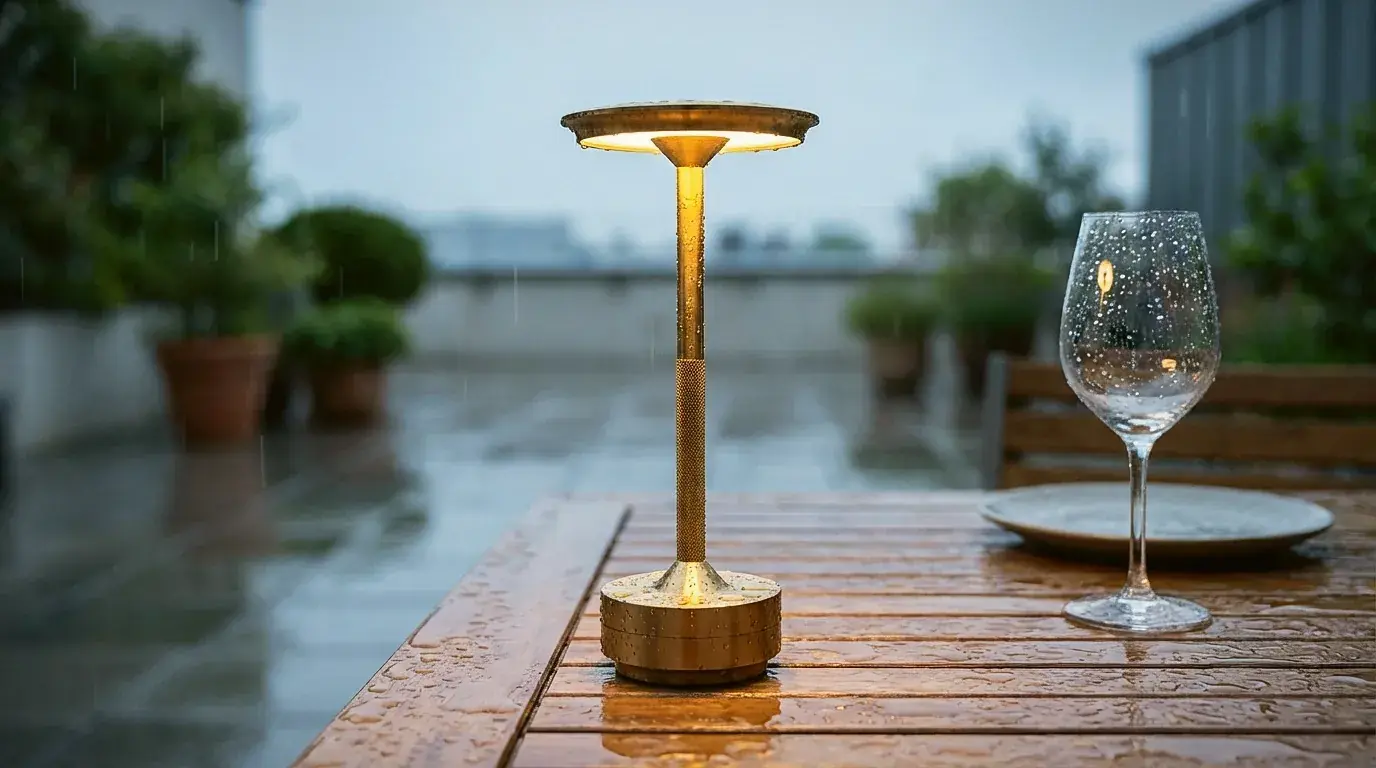
| Outdoor entertaining | Works short-term, no IP rating | IP44-rated, weeks of runtime | Rechargeable |
| Emergency / power outage | Convenient (batteries stockpiled) | Depends on charge state | Disposable (slight edge) |
| Children's room / novelty | Cheap, disposable if broken | Overkill for a $10 nightlight | Disposable |
| Guest room / Airbnb | Requires constant battery checks | Charge before guests arrive, done | Rechargeable |
For everyday use, there is no scenario where disposable batteries outperform rechargeable. The only case for disposable is emergency backup or ultra-cheap novelty lights where you do not care about light quality.
For a bedroom-specific guide, see cordless bedside lamps. For outdoor use, see our patio lighting guide.
What to Look for When Buying Rechargeable
If you have decided rechargeable is the way to go (it is), here are the five specifications that matter:
-
Battery life: 20+ hours minimum — anything less means charging every few days. Premium lamps at 90-109 hours mean charging monthly.
-
USB-C charging — the universal standard. Avoid proprietary docks or micro-USB. USB-C means any cable, any adapter, anywhere.
-
2700K warm white light — this is the colour temperature that creates warm, inviting atmospheres and does not disrupt sleep. If a lamp does not specify its colour temperature, it is probably cool white.
-
Touch dimmer with 3+ levels — brightness control is essential. You want reading light at full power and a gentle glow at minimum. Touch dimmers (tap the base) are the modern standard.
-
Metal and glass construction — rechargeable lamps are a long-term investment. Metal bodies, glass diffusers, and brass finishes age gracefully. Plastic does not.
For a full spec-by-spec breakdown, read our complete buying guide.
The Bottom Line
"Battery operated table lamp" is a search for cord-free convenience. That convenience now comes in two forms: disposable batteries (cheap upfront, expensive and wasteful over time) and rechargeable lithium-ion (higher upfront cost, essentially free to operate for a decade).
In 2026, rechargeable is the standard — and it is not close. Better light, lower long-term cost, zero waste, and a product that improves your space instead of cluttering your battery drawer.
Browse the full cordless rechargeable collection or start with the best cordless table lamps for a ranked comparison.